
Last updated August 26, 2026
Free on-site gate assessment - hinges, posts, and your LiftMaster or Nice gate operator checked before anything is quoted
The assessment is free and the quote is the invoice.
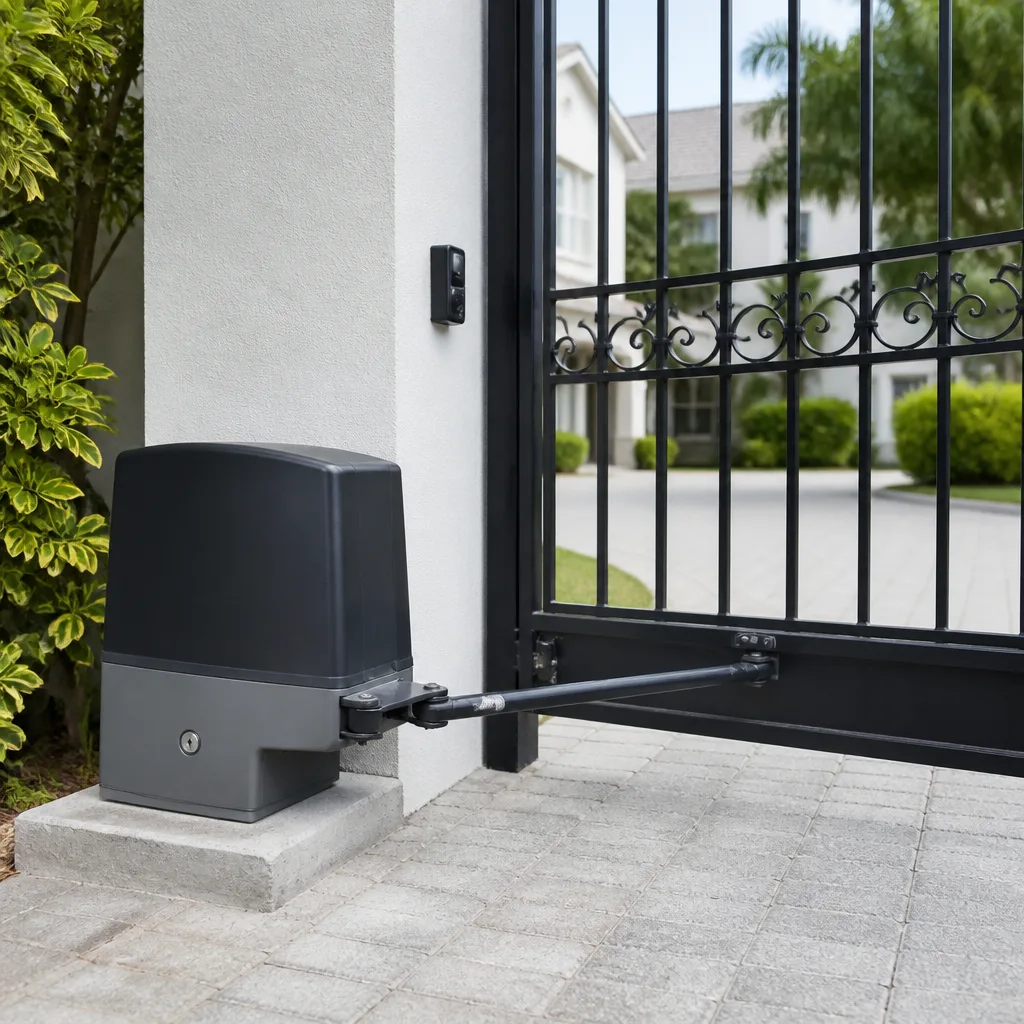
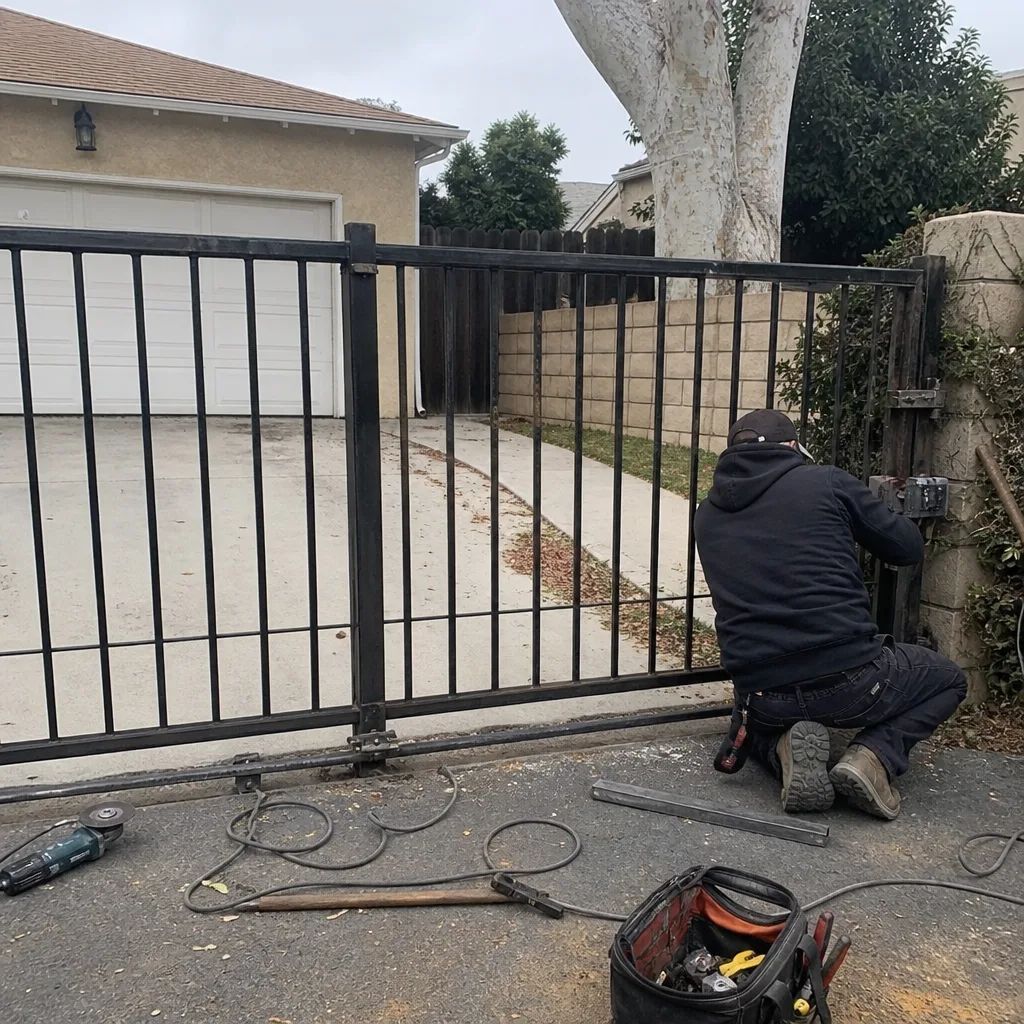 Before
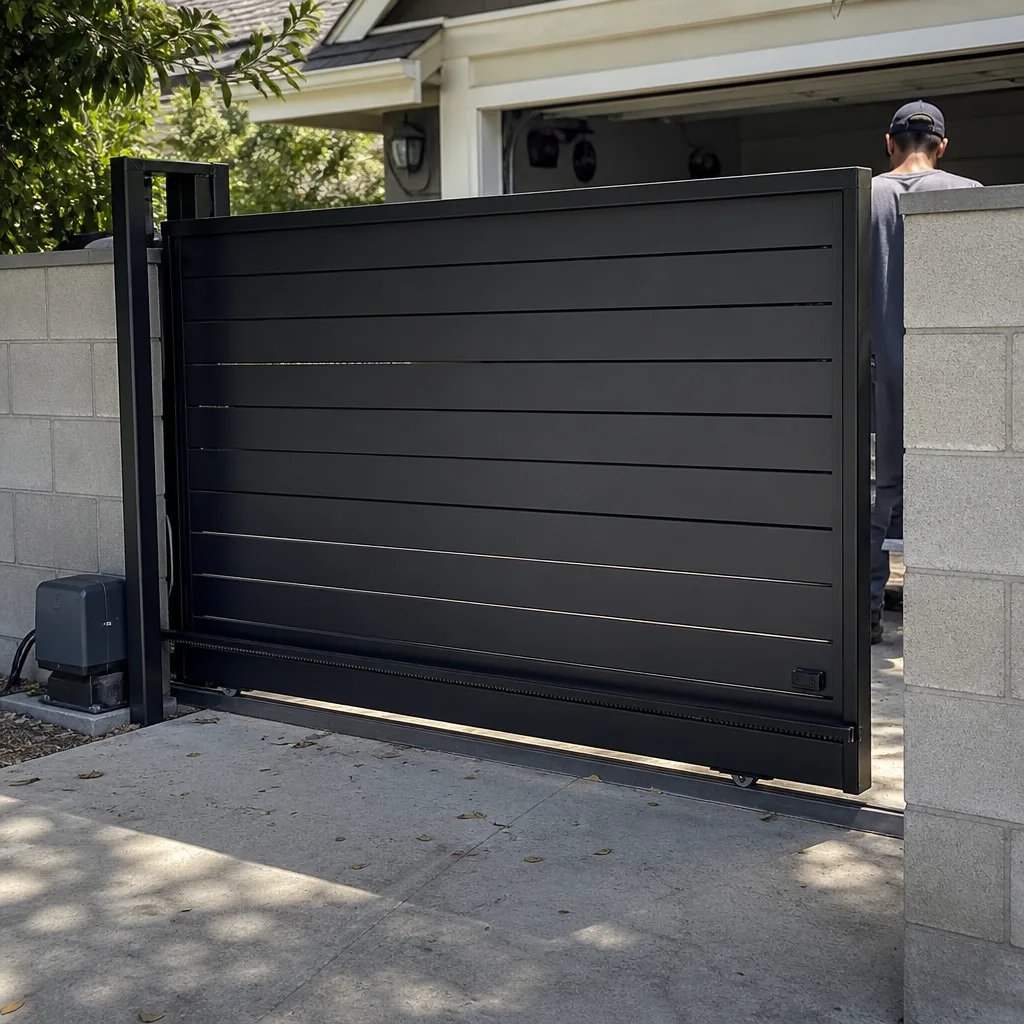 After
After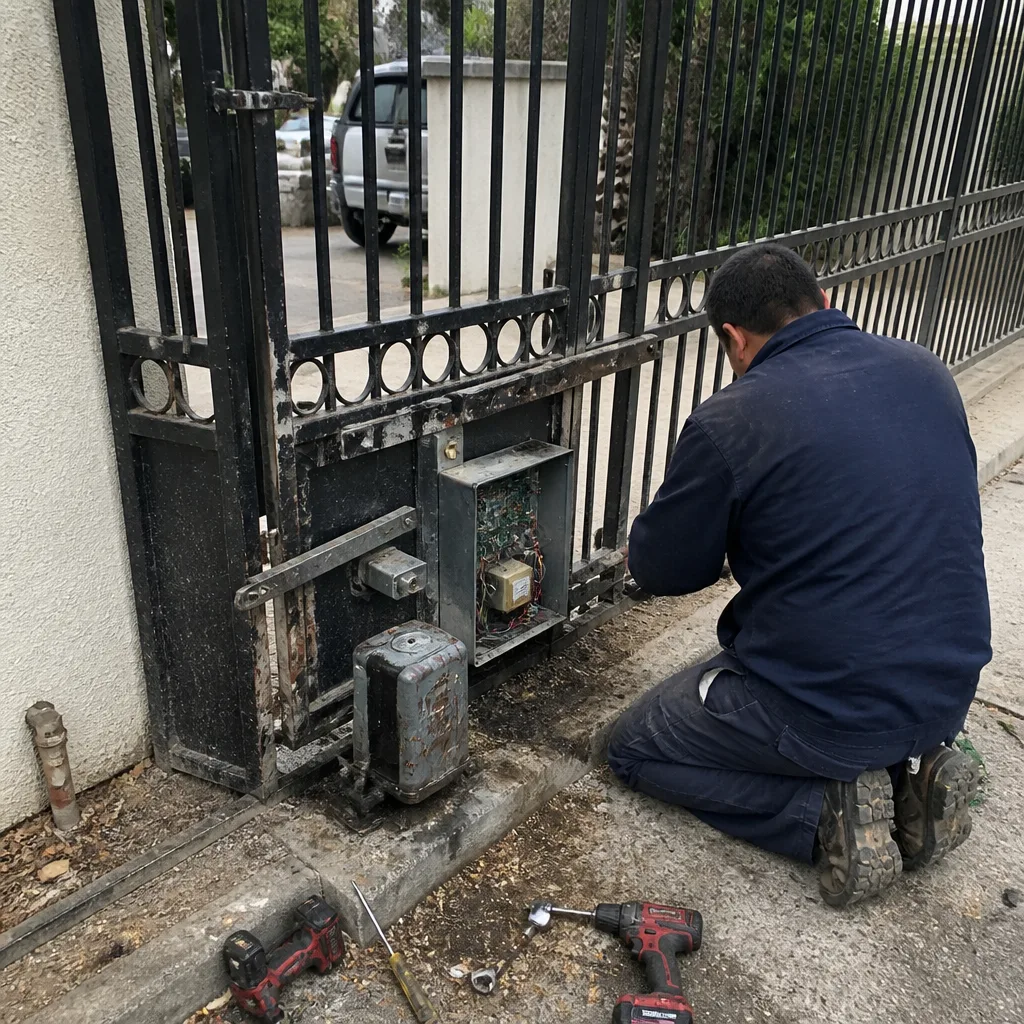 Before
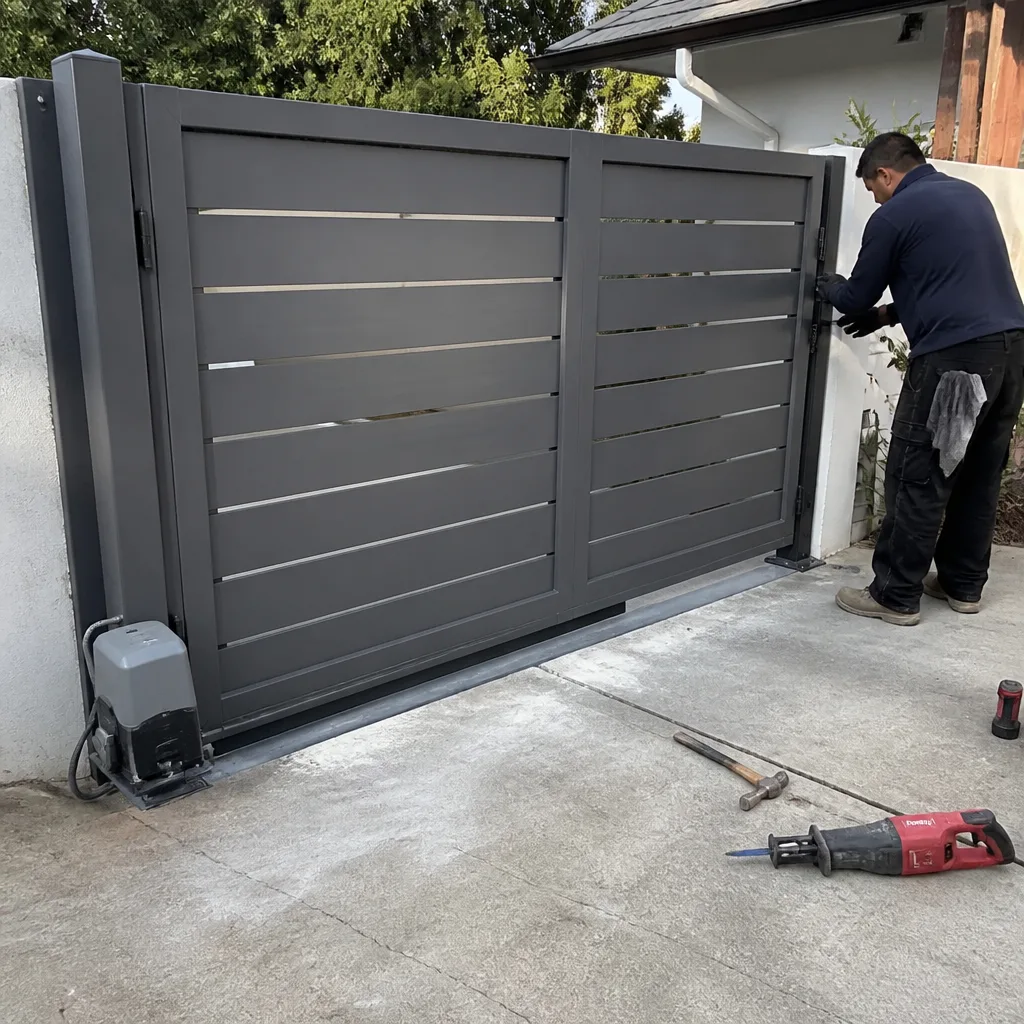 After
After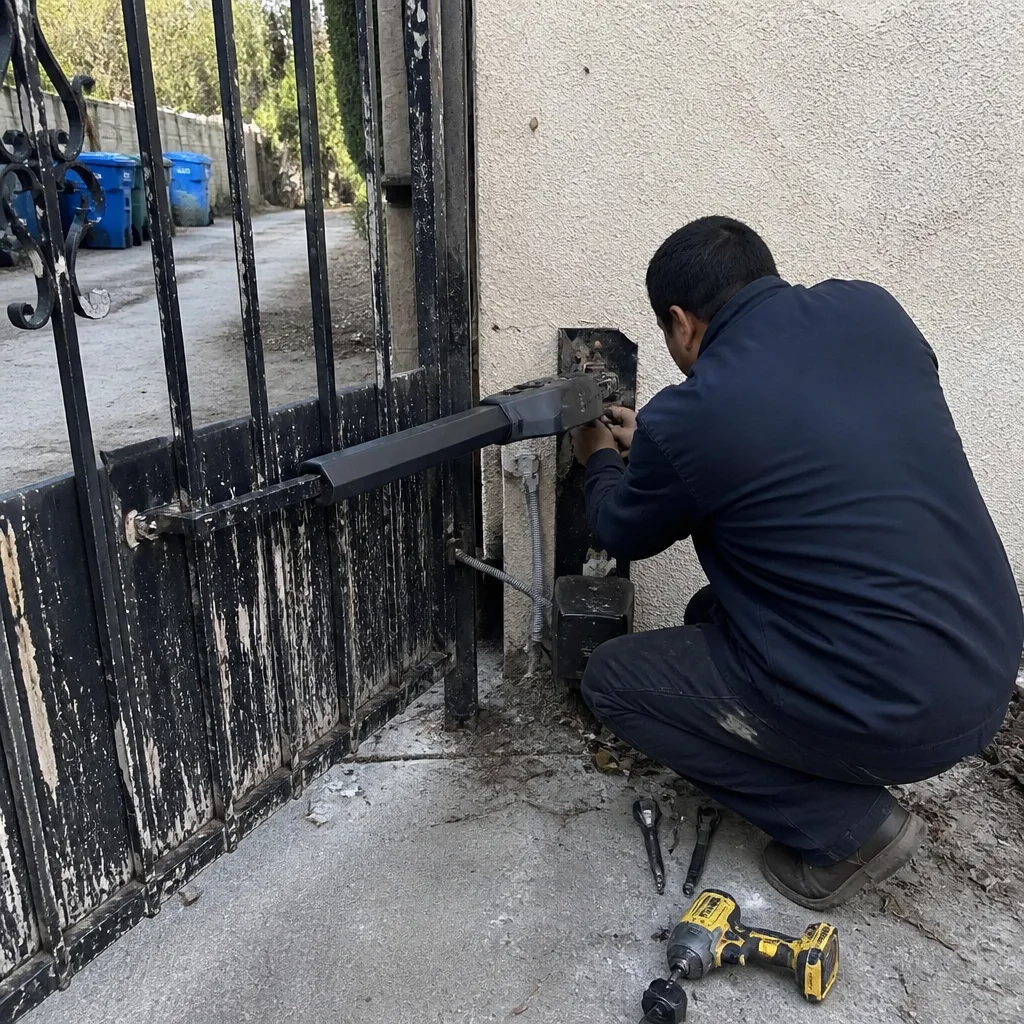 Before
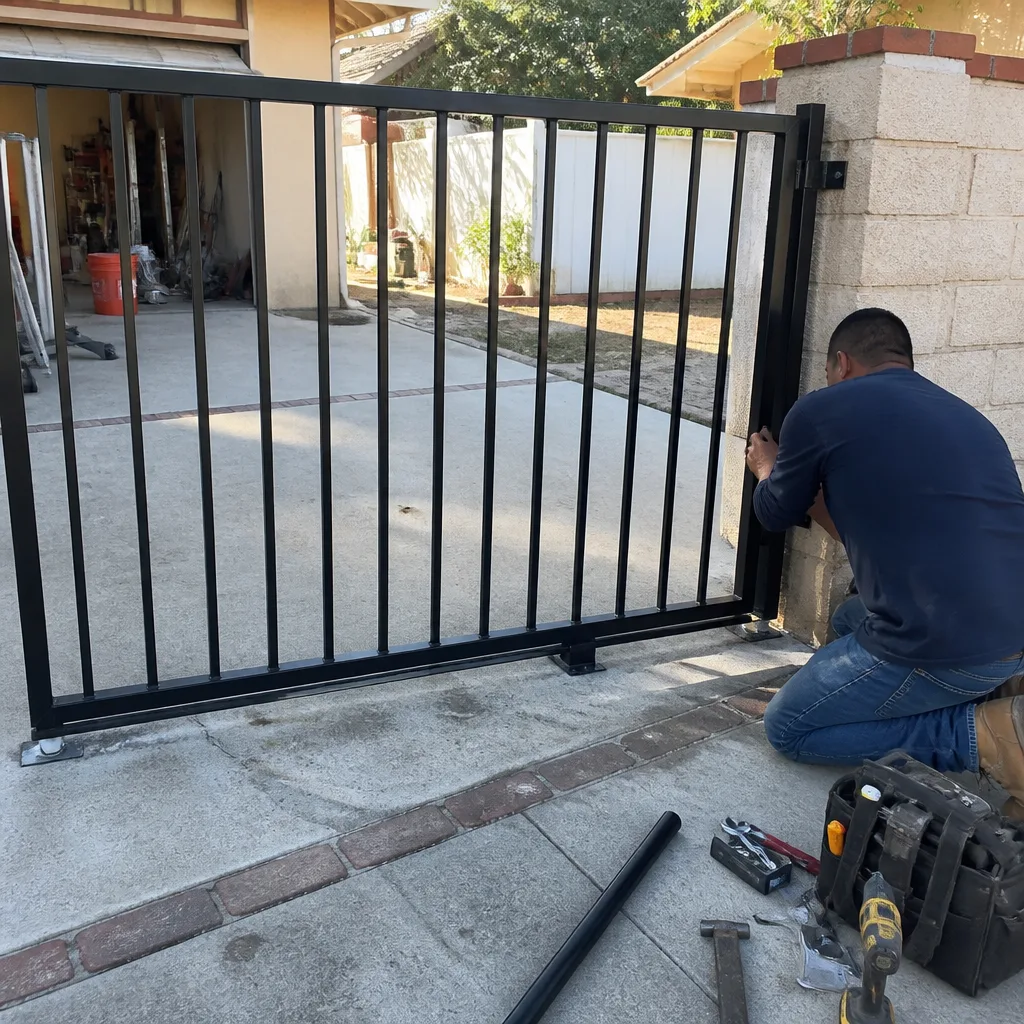 After
AfterSeasonal Gate Repair Care for Granada Hills: Year-Round Homeowner’s Guide
A wrought iron gate that looked fine in March can be dragging its post by November, and the culprit is usually the winter rains that softened the soil around an already marginal concrete footing. The problem sat invisible for months until the dry season baked that softened ground into a permanent lean. This guide breaks down the four real stress periods we see in Granada Hills, what each one does to your gate, and exactly what to check, month by month, so a $200 hinge adjustment never becomes a $2,000 post reset. For professional help with any of these issues, see our Gate Repair services.
Quick Answer
Seasonal gate care in Granada Hills comes down to four distinct stress periods: Santa Ana winds in the fall, wet-winter soil shifts from January through March, summer heat expansion that strains welds and electronics, and the long dry stretch that cracks wood gates and seizes hinges. The practical rhythm is simple: inspect after every heavy rain, prep before every wind event, lube hinges before the first heat wave, and seal wood gates in early fall before the air turns bone-dry.
Table of Contents
- Why Granada Hills Has Four Gate Seasons (and None of Them Are on a Calendar)
- The Month-by-Month Gate Maintenance Calendar
- The 48-Hour Santa Ana Wind Prep Checklist
- How to Check for Gate Post Shift After Wet Weather (and What Tolerance Actually Means)
- Summer Care for Automatic Gate Operators: Heat, Batteries, and Control Boards
- Wood Gate Care During the Dry Stretch: Cosmetic Cracks vs. Structural Failure
- Common Mistakes to Avoid
- When to Call a Professional
- Frequently Asked Questions
- The Bottom Line
Why Granada Hills Has Four Gate Seasons (and None of Them Are on a Calendar)
People ask us about “spring maintenance” or “winterizing” a gate, and the honest answer is those terms don’t map to what actually happens in the San Fernando Valley. Granada Hills sits far enough inland that we get real heat, close enough to the passes that wind becomes a weapon, and geologically positioned so that clay-heavy soil expands and contracts with moisture in ways that punish concrete footings. What we actually see, year after year, are four distinct stress periods:
- Santa Ana wind season (October through December): Sustained 40 to 60 mph gusts with dry air. Wind load pushes against the full face of the gate, transfers that force to hinges and posts, and finds every loose bolt, worn bearing, or marginal weld. A gate that’s slightly loose in calm air becomes a battering ram in a Santa Ana.
- Wet-winter soil shift (January through March): Rain saturates the clay soil around gate posts. Clay expands when wet, then contracts and cracks when it dries. That cycle loosens the bond between concrete footing and surrounding earth, which lets posts lean, twist, or sink. The lean you notice in June usually started as a small shift during February rains.
- Summer heat expansion (June through September): Steel and wrought iron expand in 100-plus degree heat. Welds that were under tension all winter get pulled harder. Automatic operator components, especially control boards and batteries inside black metal boxes, bake in direct sun and degrade faster than their rated lifespan suggests.
- The dry stretch (August through November): The air humidity drops into single digits. Wood gates lose moisture rapidly, causing shrinkage, checking, and cracking. Hinge grease thickens or dries out. Everything that moves starts to bind, squeal, or stick.
Each period demands a different kind of attention, which is why a generic “check your gate in spring” list doesn’t help a homeowner in Granada Hills. You need to match the task to the actual threat, in the month when that threat is live.
The Month-by-Month Gate Maintenance Calendar
Here’s the calendar we give homeowners when they ask what they should be doing and when. It’s built around Granada Hills weather patterns, not textbook seasons. Each task takes 15 minutes or less, and most of them are visual checks.
January: Post-Rain Inspection, Part One
After the first substantial rain (half an inch or more), walk out and look at the ground around each gate post. You’re looking for water pooling at the base, soil erosion that’s exposed the top of the concrete footing, or any visible gap between the soil and the concrete. Gaps mean the ground has already started shifting. Also check that the gate still closes fully and latches without lifting or dragging. Want a deep dive on what a healthy gate system should look like? Our Gate Repair in Granada Hills page walks through the most common failure points we find.
February: Post-Rain Inspection, Part Two (The Critical One)
February is the month that determines whether you’ll need a repair this year. By now the soil has gone through at least one wet-dry cycle, and any post that was marginal last summer will show it. Do the level test described in the next section. Check every hinge bolt with a wrench, not just your fingers. Look at the gate’s reveal (the gap between gate and post at the latch side). If that gap was even in October and it’s uneven now, the post has moved.
March: Hinge and Hardware Service
As the soil starts to dry, hinges that gritted through winter rain will start to stick. Clean each hinge with a wire brush, then apply a silicone-based lubricant. Avoid WD-40 as a lubricant: it’s a penetrant and solvent, which means it cleans but doesn’t leave lasting protection. You want actual hinge grease or a dry silicone spray. Check all bolts for looseness and torque them down. If a hinge has visible play in the barrel, that’s wear, not adjustment, and it needs replacement.
April: Operator Test and Safety Check
Before heat arrives, test your automatic gate operator’s full cycle. Open and close it three times, listening for changes in pitch, grinding, or hesitation. Test the auto-reverse by placing a 2×4 or a rolled-up garden hose across the gate’s path and closing the gate. If the gate doesn’t reverse when it hits resistance, stop using the operator and get it serviced. That’s a safety issue, not a convenience issue.
May: Pre-Heat Bearing and Roller Check
This is the month to lube wheel bearings on rolling gates and clean the track. Track debris plus 100-degree heat plus a dry bearing equals a gate that binds exactly when you need to leave for work. Use compressed air or a leaf blower to clear the track, then check roller bearings for wobble. A roller that’s rough to spin now will seize in August.
June through August: Monthly Operator Box Checks
During peak heat months, check the control box once a month. Open it (power down first), look for ants or spiders, blown capacitors, or any plastic component that looks melted or discolored. More on this in the summer section below. Check that the operator’s gearbox has visible lubrication and isn’t running dry.
September: Wood Gate Sealant (If Applicable)
If you have a wood gate, September is when you seal it, before the driest stretch of the year. Once the Santa Anas start in October and the humidity craters, wood that’s already lost its protective finish will crack fast. More specifics in the wood gate section below.
October: Santa Ana Prep
Do the full 48-hour wind prep checklist (below) before the first forecasted Santa Ana event. This is the single most important task on this calendar, because wind damage is the kind of damage that totals a gate, not just bends it.
November: Post-Santa Ana Damage Assessment
After each major wind event, check all the things you prepped in October. Look for new cracks in welds, loose bolts, hinge sag, and any change in gate alignment. Wind loading weakens things incrementally; the damage from a second wind event is always worse because the first one loosened the structure.
December: Year-End Structural Review
Once a year, do a full structural review: level check on the posts, weld inspection with a flashlight, pull test on each hinge, and a cycle test on the operator. If anything fails, address it before winter rains start again. If you’re thinking about replacing a gate rather than repairing it, our Gate Installation in Granada Hills page covers what a properly built gate system includes.
The 48-Hour Santa Ana Wind Prep Checklist
Santa Ana winds in Granada Hills regularly hit 50 mph, and we’ve seen gusts over 70 mph in the canyons. A solid gate with good hardware survives those winds. A gate with one loose hinge bolt or a partially seized roller does not. Here’s the 48-hour checklist we recommend before any forecasted wind event:
- Clear the swing path and track. Remove anything within three feet of the gate’s full swing arc: trash bins, potted plants, kids’ toys, garden tools. Wind will blow loose objects into the gate’s path and turn a binder into a jammed gate at the worst moment.
- Wrench check every fastener. Hinge bolts, post brackets, latch hardware, and operator mounting bolts. Use a socket wrench or crescent wrench. A bolt that’s finger-tight today is a missing bolt by tomorrow.
- Disconnect and test the manual release. If your gate has an automatic operator, pull the manual release and verify you can open and close the gate by hand smoothly. If wind knocks out power mid-cycle and the manual release is rusted or jammed, you’re trapped in your own driveway.
- Charge the battery backup. If your operator has a battery backup, make sure it’s holding charge. Wind storms cause power outages. A gate stuck open during a Santa Ana is a security hole on the exact night you don’t want one.
- Remove or secure anything hanging from the gate. Signs, decorations, mail pouches, seasonal wreaths. They catch wind and add levered force to the entire structure.
That’s it. Fifteen minutes of checking beats a $900 weld repair and a gate that won’t close when the wind is howling.
How to Check for Gate Post Shift After Wet Weather (and What Tolerance Actually Means)
This is the check we teach every homeowner, because post shift is the root cause behind most “mysterious” gate problems, from stuck latches to operators that trip their safety sensors. You need a level and a tape measure. That’s the whole toolkit.
Step 1: Level the Post
Place a 24-inch or longer level against the post on two faces: the face parallel to the gate (front to back) and the face perpendicular (side to side). The bubble should sit centered. If it’s out either way by more than a quarter of a bubble, the post is out of plumb. Now, a note on tolerance: no post is perfectly plumb, and a tiny lean that’s been there for years is not an emergency. What matters is whether the lean is new and whether it’s getting worse.
Step 2: Measure the Reveal
The reveal is the gap between the latch-side edge of the gate and the latch post, measured at the top, middle, and bottom. On a properly hung gate, these three measurements should be within an eighth of an inch of each other. If the top gap is wider than the bottom gap, the gate has sagged or the hinge post has leaned. If the bottom is wider, the latch post has moved. An eighth of an inch of difference is acceptable. A quarter inch means something is shifting. Half an inch or more means the post needs a professional reset, because the gate is now carrying its weight unevenly, and every cycle is making it worse.
Step 3: Check the Concrete-to-Soil Joint
Look at the line where the concrete footing emerges from the soil. In Granada Hills clay soil, you’re looking for a visible crack or gap that opened during the previous wet period. Clay expands when wet and contracts when dry; if the footing wasn’t poured deep enough or wide enough (and in this area, a lot of older footings weren’t), the soil movement will work the concrete loose over a single rainy season. A gap of a quarter inch at the soil line means the post is no longer fully anchored.
Step 4: The Grip Test
Push the post with your body weight, watching for movement at the top. A properly set post doesn’t flex at the base; it might flex slightly along its length if it’s a long post, but the base stays rock solid. If you feel or see movement at the base, stop using the gate’s automatic operator and call for a professional reset before the next rain.
Here’s why this check matters in Granada Hills specifically: our clay soil goes through a more extreme wet-dry cycle than most of Los Angeles. A post that passes the grip test in September can fail it in February after three good rains. If you catch a quarter-inch shift in February, the fix is usually a day’s work: dig out around the footing, re-bed in fresh concrete, reset the post, re-hang the gate. If you let it ride until June, the post leans further, the gate drags, welds start popping, and now you’re replacing the post, the hinges, and possibly the gate panel. Fix the post without the panel and you fix it once.
Summer Care for Automatic Gate Operators: Heat, Batteries, and Control Boards
Granada Hills summers are hard on automatic gate operators in ways the manufacturer’s manual barely mentions. Most operator components are rated for operating temperatures up to 140 degrees Fahrenheit, which sounds like plenty until you realize the inside of a black metal control box in direct August sun can hit 160 degrees. Heat kills electronics exponentially: every 10 degrees above rated temperature halves the expected lifespan of electrolytic capacitors and other board components.
Battery Backup Health
If your operator has a battery backup (common on LiftMaster and FAAC units), check it when the heat arrives. Heat accelerates battery aging. A sealed lead-acid backup battery that’s three years old and has spent two summers in a hot control box is probably near the end of its useful life even if the operator still cycles fine on AC power. The test is simple: kill the breaker or unplug the operator, then run a full open-close cycle on battery only. If the gate moves slower than it does on AC power or the low-battery indicator lights, replace the battery before you need it. A battery that fails during a Santa Ana power outage leaves your gate stuck in whatever position it was in when the power dropped.
Control Board Cooling
Most homeowners never think about where the control box is mounted. If yours is on a west-facing wall or attached to a metal post in full afternoon sun, it’s cooking. We regularly see BFT and Mighty Mule boards in Granada Hills with heat-related capacitor failure after just two or three summers, and the pattern is always the same: box in direct sun, no shade, black enclosure. The fix isn’t complicated: if you can’t relocate the box, add a shade panel or plant something that blocks afternoon sun without blocking access. We’ve also seen homeowners leave the control box door open during heat waves, which helps with temperature but invites ants, spiders, and dust. Keep the door closed and solve the shade problem instead.
Gearbox and Lubrication
Heat thins grease in the gearbox, which sounds counterintuitive but it’s true: thin grease migrates away from the gear faces under load, leaving metal-on-metal contact. Check the gearbox for visible lubrication once in June and once in August. If the gears look dry or you’re hearing a new whine during operation, get it serviced before the gear teeth wear to the point of needing replacement. That’s the difference between a $50 lube service and a $400 gearbox rebuild.
If your operator is struggling with heat or the gate is moving unevenly, that’s a job worth calling about. We stock parts and service manuals for nine major brands including LiftMaster, FAAC, BFT, and Mighty Mule. More on what that involves on our Gate Motor & Opener in Granada Hills page.
Wood Gate Care During the Dry Stretch: Cosmetic Cracks vs. Structural Failure
From August through November, the humidity in Granada Hills drops to single digits and wood gates lose moisture at a rate that would make a cabinetmaker wince. That moisture loss causes shrinkage, and shrinkage causes checking (small surface cracks along the grain), opening of joinery, and warping. The question we hear most is: how do I know if a crack is cosmetic or structural?
The practical distinction is depth and location:
- Cosmetic checking: Surface-level cracks that follow the grain, are less than an eighth of an inch deep, and don’t run to the edge of the board or through any joint. These are normal in any wood gate that lives in the valley. They don’t affect structural integrity. Seal them and move on.
- Structural cracking: Cracks that run through a hinge mount, through a latch bore, or through the full thickness of a rail or stile. Any crack near a fastener is a structural concern, because the fastener is now sitting in compromised wood. If the crack opens and closes when you push on the gate, it’s load-bearing damage, not surface checking.
Also check for joint separation: gaps opening where rails meet stiles, especially at the four corners of the gate. A wood gate in the dry stretch will open up at its joinery if the wood wasn’t properly seasoned or if the joinery wasn’t reinforced. Corner gaps over a sixteenth of an inch mean the gate is relying on fasteners alone, and fasteners in dried-out wood lose grip quickly.
The Right Sealant for Valley Heat
Not all sealants survive a Granada Hills summer. Oil-based film finishes like varnish and polyurethane look great for one season and then peel in sheets when the heat and UV break them down. What we recommend for wood gates in this climate is a penetrating oil finish, specifically one formulated for outdoor furniture or decking: teak oil, tung oil blends, or a good-quality exterior penetrating stain-sealer hybrid. These soak into the wood fibers rather than sitting on top, which means they move with the wood as it expands and contracts. They also don’t peel. The tradeoff is you reapply them yearly, but a yearly reapplication in September takes an hour with a rag.
For a painted wood gate, keep the paint film intact. Paint is a moisture barrier, and once it starts cracking around edges and joints, moisture gets in and gets trapped. Touch up edge chips before the dry season, not after, so the wood doesn’t dry unevenly and warp. A warped gate panel is almost never repairable; a cracked paint film is.
Common Mistakes to Avoid
- Ignoring a small post lean because the gate still works. A gate sags in the hinge post, not in the middle, and a quarter-inch lean now is a half-inch by next rainy season and a torn-up driveway by the one after that.
- Replacing hinges without checking the post. We see this constantly: homeowner swaps hinge hardware to fix a sagging gate, and six months later the new hinges are sagging too because the post was the problem all along. Fix the post without the panel and you’ll fix it twice.
- Using WD-40 as a hinge lubricant. It’s a cleaner and water dispersant, not a lasting lubricant. It washes out of hinges in one rain and leaves the metal drier than before. Use actual hinge grease or a dry silicone spray.
- Sealing a wood gate in the middle of summer. Applying sealant when the wood is already bone-dry feels like it should help, but the wood has already shrunk. Sealing it then locks in the shrunken dimensions; when the wood re-expands in winter humidity, the sealed surface can’t stretch and you get deeper checking. Seal in early fall before peak dryness.
- Driving over a dragging gate instead of fixing it. When a gate drags, the weight of the gate is resting on the drag point, not on the hinges. Every open-close cycle then twists the gate frame, which eventually rips welds or pulls hinge screws loose. The dragging gate you ignore today is the weld repair you pay for in March.
- Skipping the Santa Ana prep because “the gate survived last year.” Every wind event that the gate survives with loose hardware loosens it further. Surviving a 60 mph gust with a marginally tight hinge doesn’t mean it’ll survive the next one; it means the next one has a head start on you.
When to Call a Professional
Some gate problems are perfectly fine to handle yourself: cleaning hinges, lubing a track, tightening a bolt, sealing a wood gate. For a deeper look at local repair considerations, see The Complete Guide to Gate Repair in Granada Hills. But if you’ve found post movement at the base, a crack in a weld, a control board that’s been cooking in the sun and acting erratically, or an operator that’s failed a safety-reverse test, stop and call someone who does this every day. A gate that fails in the middle of a cycle is dangerous; the springs, cables, and pinch points on automatic gates have real force behind them. Welding on a post that looks “mostly fine” without understanding the load path creates a situation that fails at the worst moment. Gatewood Fence & Gate offers free estimates in Granada Hills, and we do on-site welding so your gate never has to leave the driveway. Call (760) 361-6706 to talk it through.
Frequently Asked Questions
Do a quick visual check monthly and a deeper inspection quarterly, aligned with the calendar in this guide. After any heavy rain, do the post-shift check within 72 hours. Before any forecasted Santa Ana event, do the 48-hour wind prep checklist. All together, you’re looking at about four hours of attention per year.
A post reset in Granada Hills typically runs between $450 and $1,200, depending on post size, whether the footing needs to be repoured, and whether the gate has to be re-hung and re-balanced. The lower end covers a post that’s still structurally sound but was set in a too-shallow footing. The higher end covers digging out a severely compromised footing, pouring deeper concrete, resetting the post, and re-hanging the gate with any necessary hinge work. Call Gatewood Fence & Gate at (760) 361-6706 for an exact quote before any work starts, and remember estimates are free.
A penetrating oil finish (teak oil, tung oil blend, or a quality exterior penetrating stain-sealer) is the best choice for a wood gate in Granada Hills because it moves with the wood through our radical wet-dry cycles instead of cracking and peeling like a film finish. Apply it in September before the dry stretch peaks, and reapply yearly for best results.
You don’t need to disconnect it preemptively, but you should test the manual release before every wind event so you know you can open the gate by hand if power drops or the operator jams mid-cycle. If your operator has a battery backup, charge it fully before the winds arrive. A stuck-open gate is a security problem on the night you especially don’t want one.
Use a level on two faces of the post and measure the reveal (the gap between gate and post at the latch side) at top, middle, and bottom. If the reveal measurements vary by more than a quarter inch, or the concrete-to-soil joint has opened up a visible gap, the post has shifted and should be assessed. Full step-by-step instructions are in the post-shift section above.
Yes, to a point: wood expands with winter moisture and shrinks in summer heat, so a gate that swings quietly in January might rattle or feel looser in September. But if the change is sudden or accompanied by visible gaps at joints, abnormal sag, or a latch that’s become hard to engage, that’s the gate telling you something structural has shifted, and it’s worth getting a professional opinion before it worsens.
Yes, we’re certified to service nine major brands: LiftMaster, FAAC, BFT, Linear, Viking, Ghost Controls, DoorKing, Elite, and Mighty Mule. If your operator is from one of these brands and it’s acting up after a heat wave or a wind event, call (760) 361-6706 and describe what it’s doing. We’ll tell you over the phone whether it sounds like a board, a battery, or something mechanical.
The Bottom Line
Granada Hills gates fail in predictable patterns, and the patterns follow the weather, not the calendar. Post-check after every rain, prep for every Santa Ana, lube before the first heat wave, and seal wood before the dry stretch hits. That rhythm catches problems when they’re $50 hinge adjustments and $200 post re-beds, not $2,000 structural rebuilds. The difference between a gate that lasts 20 years and one that needs replacement in five is less about the materials you chose and more about whether you noticed the small shift when it happened. Show me the gate closing on its own and I’ll show you where it’s failing. If you find something that needs attention, call (760) 361-6706. Hal will be there himself, or you can drive to the shop and look him in the eye. For more guides & resources on gate maintenance and repair, visit our blog.
Written by Hal Gatewood, Owner at Gatewood Fence & Gate, serving Granada Hills since 2001.