
Last updated August 26, 2026
Free on-site gate assessment - hinges, posts, and your LiftMaster or Nice gate operator checked before anything is quoted
The assessment is free and the quote is the invoice.
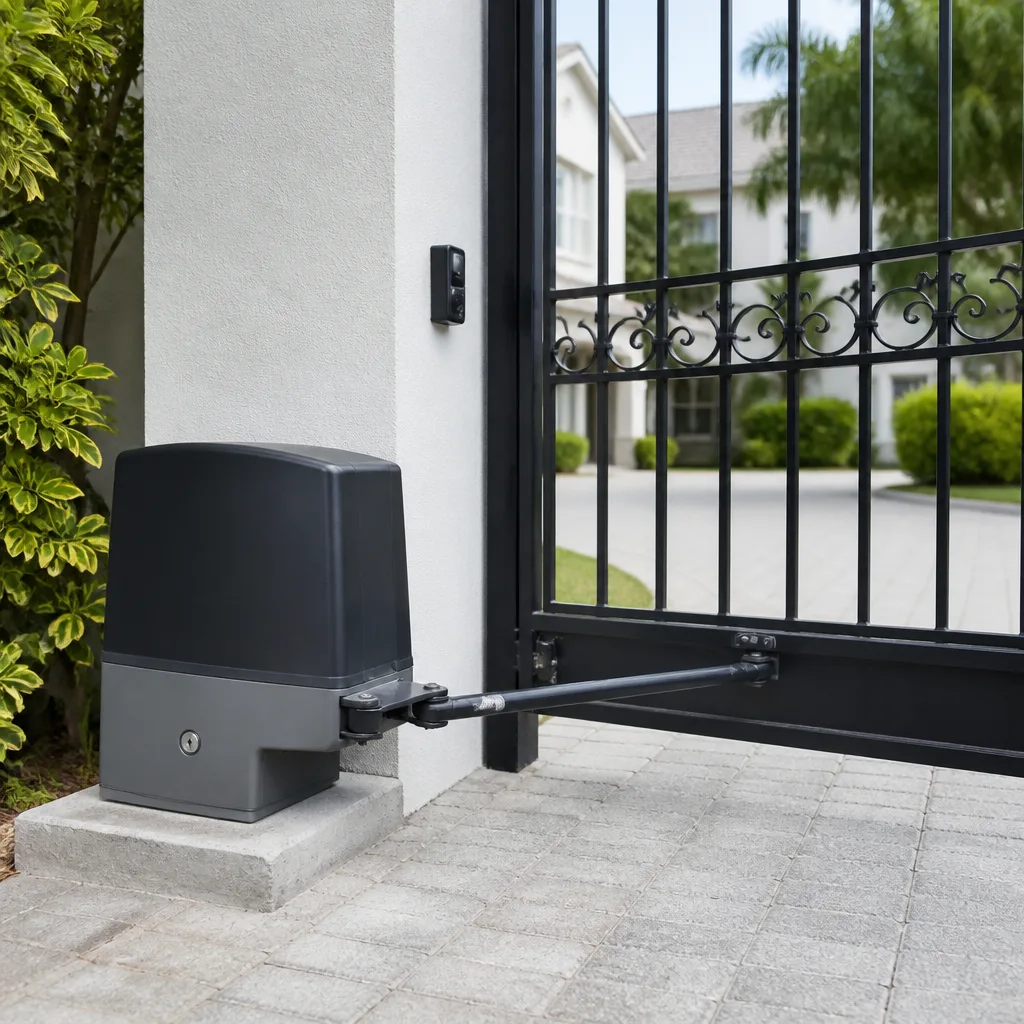
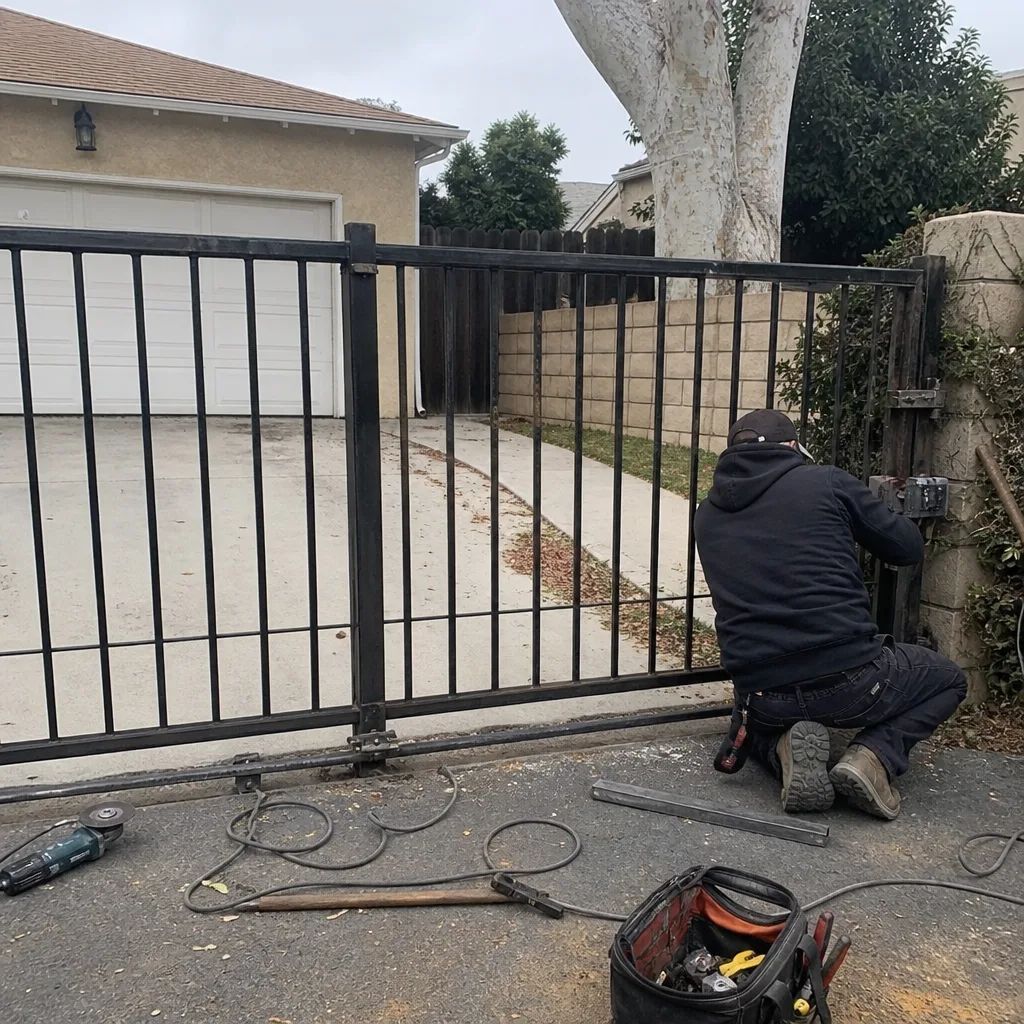 Before
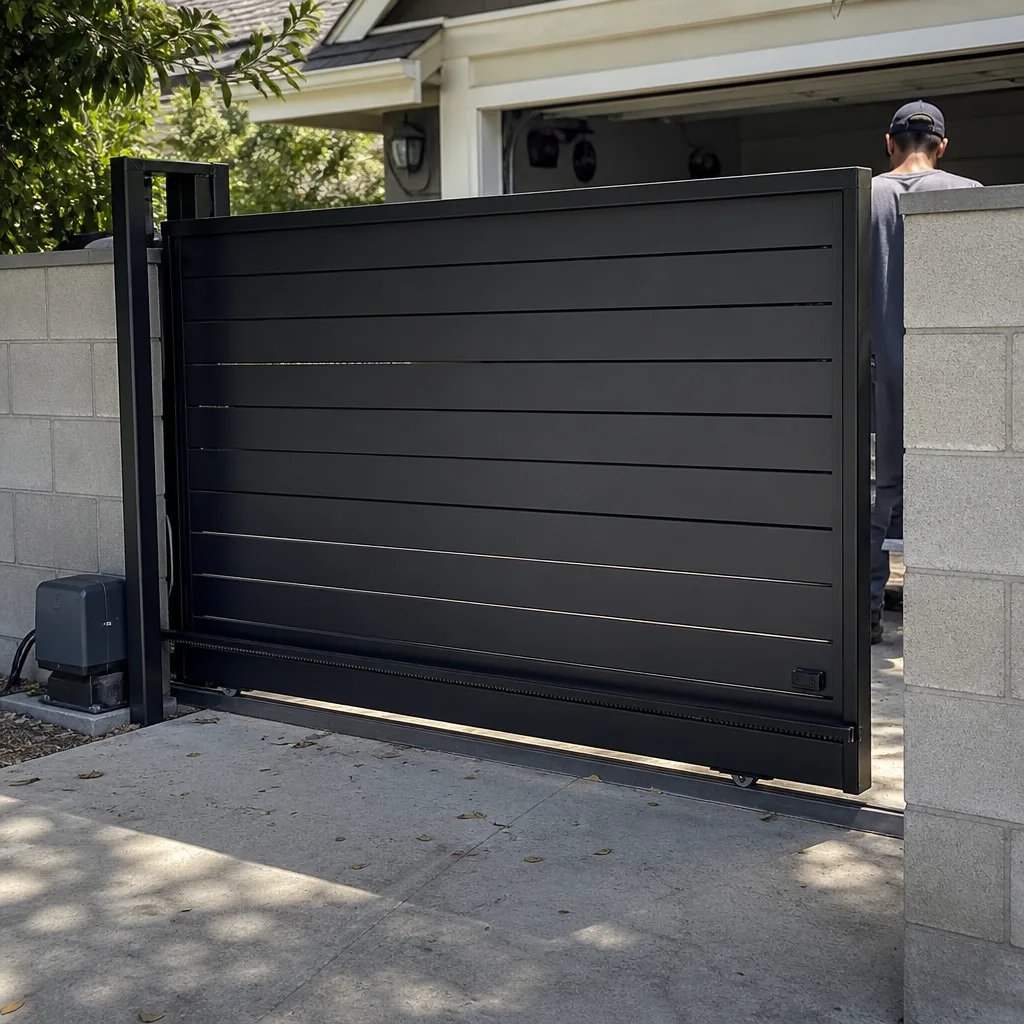 After
After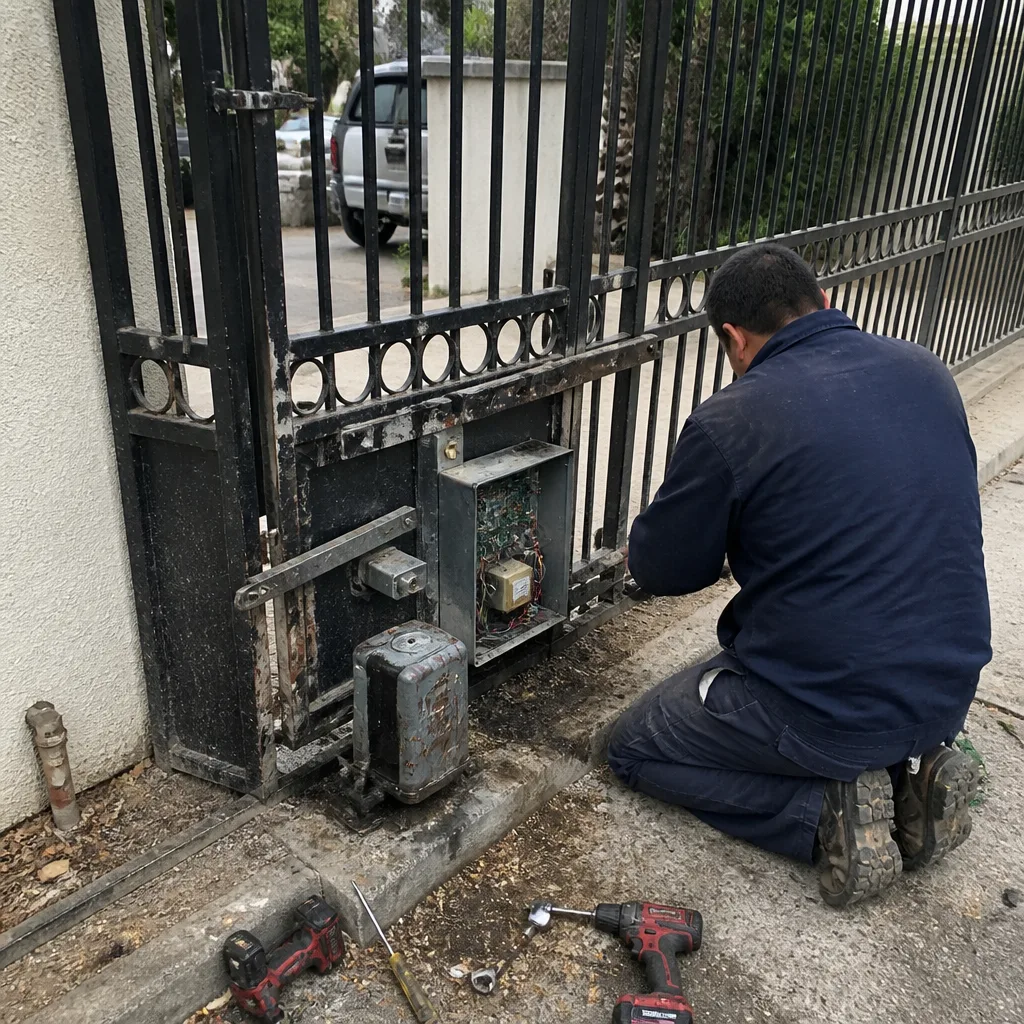 Before
 After
After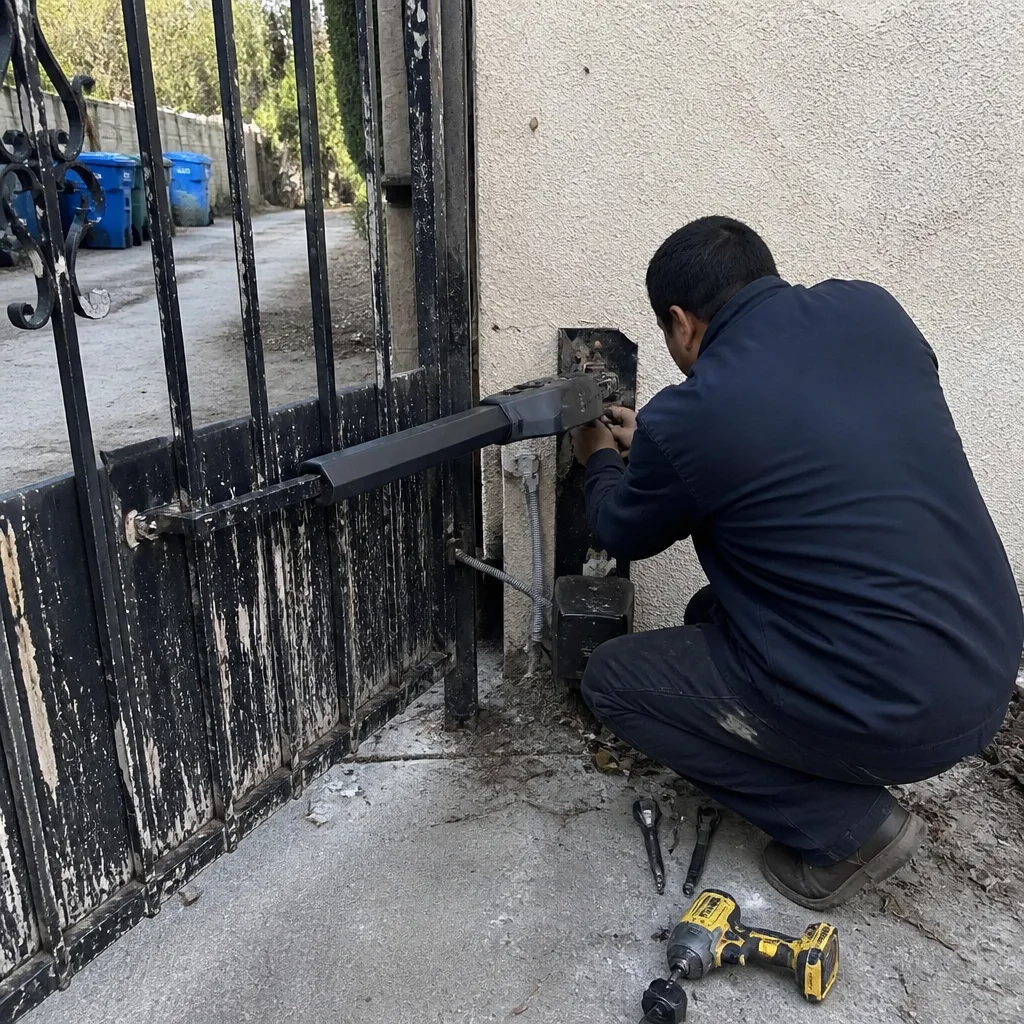 Before
 After
AfterGate Repair Maintenance Checklist for Granada Hills Homeowners
Most gate hinges in residential Granada Hills show measurable wear within 18 months of installation. Not because the hardware is bad. Because nobody ever puts a single drop of the right lubricant on them after the installer backs out of the driveway. This guide is a checklist you can actually use. Not one you laminate and forget in a kitchen drawer. We’ll walk through what a developing problem looks and feels like at each inspection point on your gate, so you can tell normal wear from a failure that’s about to cost you real money. If you live in Granada Hills, your gate deals with a specific set of conditions: fine dust, hard water, and Santa Ana winds that punish hardware. We’ll cover all three.
Quick Answer
A gate maintenance checklist for Granada Hills homeowners comes down to inspecting five components monthly: hinges, latch, track or wheels, gate posts, and the automatic opener. Look for sag, drag, screech, wobble, and any change in how the gate sounds or moves. Lubricate pivot points every 3 to 4 months with the right product, and tighten hardware after Santa Ana wind events. Most developing problems announce themselves with sound or motion long before the gate actually fails.
Table of Contents
- Hinge Inspection: What a Failing Hinge Feels Like
- Latch and Lock: The Part That Gets Yanked
- Track and Wheels: Granada Hills Dust Is Not Your Friend
- Gate Posts: The Part Nobody Checks Until It’s Too Late
- Automatic Opener Maintenance: Dust, Minerals, and Santa Anas
- A Seasonal Schedule That Actually Matches Granada Hills Weather
- Common Mistakes to Avoid
- When to Call a Professional
- Frequently Asked Questions
- The Bottom Line
Hinge Inspection: What a Failing Hinge Feels Like
Here’s the thing about hinges: they don’t fail suddenly. They fail slowly, and they tell you the whole time. A gate sags in the hinge post, not in the middle, and that’s where you start looking. Walk up to your gate and lift it by the latch side. A healthy gate should have no vertical play at all. If you can lift the free end even a quarter inch and feel a clunk, that’s a hinge bushing or a bolt loosening. On a heavy ornamental iron gate in Granada Hills, that quarter inch becomes a half inch within six months, and then the latch stops lining up, and then you’re dragging the gate across the concrete instead of swinging it.
Here’s what to check at each hinge:
- The sound. A dry hinge creaks. A worn hinge clunks. Creak means lubricant. Clunk means metal-on-metal contact that shouldn’t exist, and no amount of spray will fix it.
- The gap. Look at the space between the hinge leaf and the post. It should be consistent top to bottom. A wider gap at the top means the gate is pulling away under its own weight.
- The hardware. Grab a wrench and check the bolts on both the gate side and the post side of each hinge. In Granada Hills, thermal cycling from hot days to cool nights works bolts loose faster than most people realize. We see it constantly: a perfectly installed gate with bolts backed out a full turn after two seasons.
- The swing. Push the gate through its full arc. It should move smoothly with uniform resistance. A gate that accelerates on its own at any point is telling you something is out of alignment, and that something is usually a hinge.
One of the most common calls we get in Granada Hills is a gate that suddenly won’t close. The homeowner assumes the opener died. But the opener is fine; it’s a hinge that wore down enough to let the gate drop, and now the latch won’t reach the catch. Fix the panel without the post and you’ll fix it twice. That’s a direct quote from Hal Gatewood, and he’s said it standing in hundreds of Granada Hills driveways while showing someone a hinge that should have been replaced two years earlier.
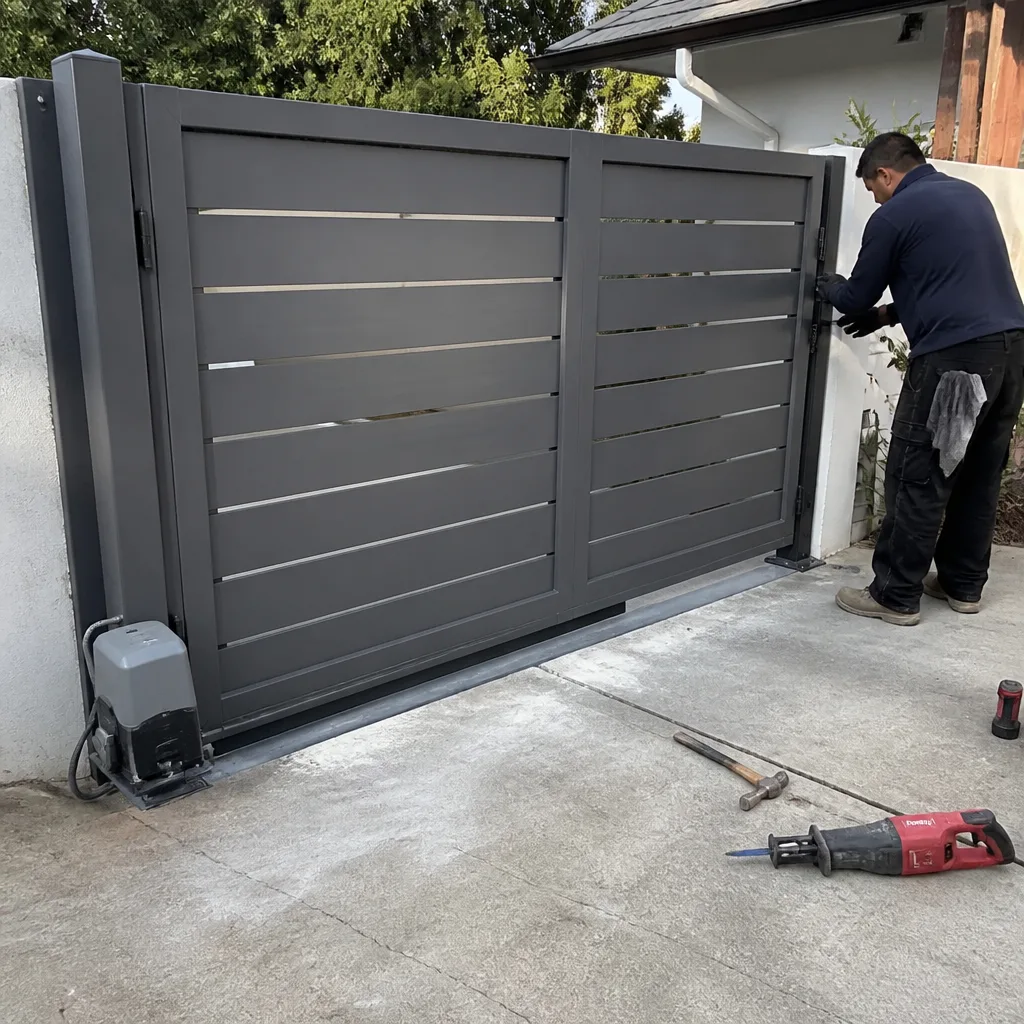
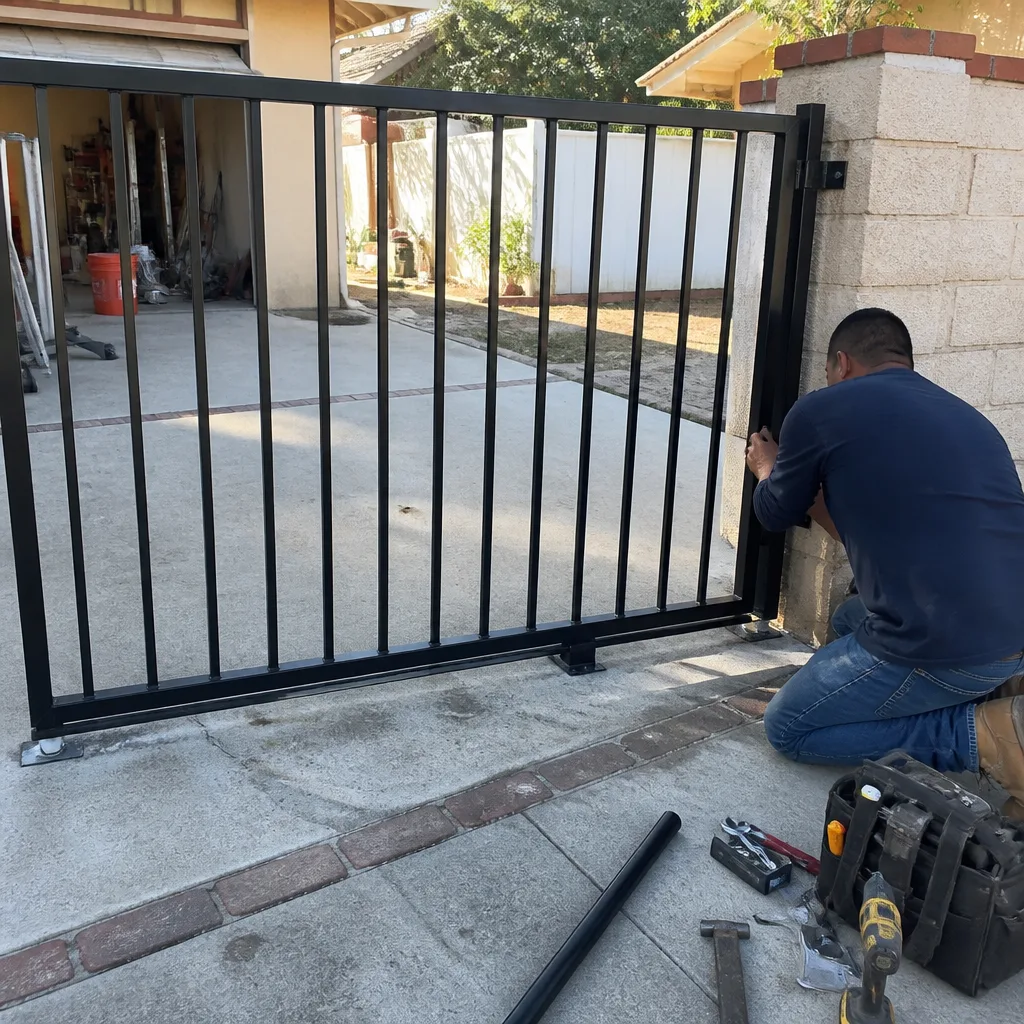
For hinges, the two-minute check is the lift test and the sound check. The tool-required check is tightening the bolts and inspecting bushing wear, which takes about ten minutes if you have a basic wrench set. If the hinge itself is worn out, that’s a welding or replacement job. We do that gate repair work right in your Granada Hills driveway, with the gate still on the property, not hauled off to some shop.
Latch and Lock: The Part That Gets Yanked
The latch is the most abused component on any residential gate in Granada Hills. It gets yanked, kicked with a foot, shouldered while carrying groceries, and hit by wind gusts that swing the gate hard against the stop. Every one of those events takes a little life out of it. The good news is that a failing latch announces itself early, and the check takes under a minute.
Here’s the full check, in order:
- Strike alignment. Stand with the gate closed and look at where the latch meets the catch or strike plate. The latch tongue should enter the opening dead center, not dragging on the top or bottom edge. A scratch pattern on the strike plate tells you the gate has already sagged and the latch has been scratching paint for a while.
- Effort required. The mechanism should operate with a light throw. If you have to muscle the latch handle more than a nudge, something is binding. Often it’s just dust and mineral buildup in the latch body. Sometimes it’s a bent latch tongue from a wind slam.
- Return spring. Release the latch handle. It should snap back to position on its own. If it flops or moves slowly, the spring has failed or the mechanism needs cleaning. A lazy latch will eventually fail to catch, and then you have a gate banging open and closed in every Santa Ana gust.
- Hardware tightness. Grab the latch assembly and try to wiggle it. There should be no movement between the latch body and the gate frame. We see loose latches on gates all over Granada Hills because screws into thin tube steel back out under vibration, especially on gates that get opened and closed multiple times a day.
For locks, the maintenance is simpler but easier to ignore. If you have an exterior keyed lock, add an annual lubrication with a dry graphite product and then exercise the key half a dozen times. Keyless entry pads need their battery covers checked, because Granada Hills heat accelerates battery leakage, and a corroded battery terminal will kill an otherwise fine access system. And if your latch has a bulkhead or weather cover, pop it open twice a year and blow out the accumulated dust with compressed air. The fine gray dust that blows through Granada Hills gets everywhere, and it doesn’t improve anything it touches.
Track and Wheels: Granada Hills Dust Is Not Your Friend
If you have a sliding gate, the track and wheel area is where Granada Hills conditions hit the hardest. Fine sediment collects on the track, grinds into the wheels, and turns a smooth-rolling gate into something that sounds like it’s dragging gravel. We hear it constantly: a rumble that starts as a soft grind and becomes, over months, the sound of metal eating metal.
Here’s what to look for on a monthly schedule:
- Track debris. Get down and look at the track bed. Granada Hills dust, decomposed granite, and small pebbles will accumulate, especially after wind events. Clear everything out. A broom and a shop vacuum are the right tools. Leaf blowers work, but they also fill the air with fine dust that settles right back into the track and into the wheel bearings.
- Wheel surface. Run your finger along the rolling surface of each wheel. It should be smooth. If it feels scored, grooved, or pitted, the wheel is grinding against debris that used to be in the track, and that wear is permanent. Worn wheels put stress on the gate motor, which then works harder and hotter, which shortens its life. That’s the cascade we see most often with slide gates in Granada Hills.
- Bearing feel. Spin each wheel by hand with the gate stationary. It should turn freely with no wobble. A wheel that wiggles on its axle has a failing bearing, and a failing bearing will eventually seize. A seized wheel doesn’t roll; it skids, and then the gate drags, and then the opener burns out trying to push it.
- Guide rollers. These are the vertical wheels that keep the gate from racking side to side. They should be in contact with the gate frame, but not grinding against it. A shiny wear line on the gate frame means a guide roller is too tight and it’s shaving metal every time the gate cycles.
Track and wheel checks take two minutes by eye, and ten minutes with a rag and vacuum to actually clean things. Here’s the honest part: cleaning a track is entirely DIY-safe. Replacing worn wheels or rewiring a gate operator is not, because slide gates store serious tension and weight, and a wrong adjustment on a gate motor or opener power setting can be dangerous. We regularly see Granada Hills homeowners who replaced their own wheels and then called us because the gate now slams at the end of travel, which means the limit settings were never recalibrated.
Gate Posts: The Part Nobody Checks Until It’s Too Late
Every gate failure in Granada Hills begins and ends at the posts. The posts hold the hinge leaf, the latch catch, the opener arm, and half the weight of the entire assembly. A gate sags in the hinge post, not in the middle. That’s the single most important sentence in this whole guide. The post can lean, twist, pull out of the concrete, rust at the base, or shear its anchor bolts, and every one of those failures starts small enough to miss if you’re not looking.
Here’s what to inspect:
- Plumb check. Hold a level against the post on two adjacent faces, or eyeball it against a known true vertical like the corner of your house. The post should be perfectly vertical. A post leaning even a degree or two will translate to several inches of sag at the far end of a 14-foot gate.
- Base condition. Look at where the post meets the concrete footing or the ground. In Granada Hills, the cycle of irrigation, heat, and occasional heavy rain creates a damp, mineral-rich environment at the base of every steel post. Rust starts at ground level and works up. Scrape away any loose paint or surface rust, treat with a rust converter, and repaint with a direct-to-metal enamel. If the metal is pitted or you can flake away a quarter inch of material, the post is compromised.
- Anchor bolts. If your posts are bolted to a concrete foundation rather than set in it, put a wrench on every anchor bolt twice a year. Granada Hills wind events are the perfect time to check. A gate acts as a sail in a Santa Ana, and repeated gusting creates a rocking motion that loosens anchors one degree at a time until the post is moving independently of its base.
- Sound test. Tap the post with a hammer at the base. A solid ring means the post is still structurally sound. A dull thud means internal rust or delamination, and that’s a call-worthy condition.
- Operator arm or drive chain tension. On a swing gate, inspect the operator arm where it attaches to the gate. There should be no slop at the connection. Grab the arm and try to move it; any free play means a bushing or pin is wearing. On a slide gate, check the chain or rack for proper tension. A chain that sags more than an inch at the midpoint needs adjustment. A rack with missing teeth or visible wear flat means you’re paying for metal shavings with every open-and-close cycle.
- Sensor lenses. Photo eyes and safety edge sensors need clean lenses. A microfiber cloth and a little water, nothing aggressive. The calcium in Granada Hills water will etch glass if you let irrigation overspray dry on the lens repeatedly, and an etched lens can cause false reversals or, worse, a gate that doesn’t stop when it should.
- Battery and power supply. If your opener has a backup battery, check the terminals for corrosion twice a year. Granada Hills heat accelerates battery degradation. A swollen battery case is a sign it needs replacement. If the unit is hardwired, check that the power cord hasn’t been chewed by rodents or pinched by the gate itself.
- Limit settings. The gate should stop cleanly at both ends of its travel without slamming and without coming up short. A gate that slams has lost its limit setting or its mechanical stop. A gate that stops three inches short of the closed position leaves a gap, and a gap in a Granada Hills gate is an invitation to every feral cat and leaf pile in the neighborhood.
- Manual release function. Every automatic opener should have a manual disconnect. Test it twice a year. A release that’s seized from dust and corrosion is useless in a power outage, and Granada Hills gets its share of rolling blackouts during heat waves and fire weather. If you can’t pull the release by hand, the mechanism needs servicing before you actually need it.
- Using WD-40 on gate hinges. WD-40 is a water displacer, not a long-term lubricant. It washes away real grease and leaves the hinge drier than before within a week. In Granada Hills dust conditions, a wet lubricant like WD-40 is a magnet: it attracts dust, mixes with it into a paste, and accelerates wear. Use a dry lithium or molybdenum spray instead.
- Lubricating a worn hinge to buy time. A creak means lubricate. A clunk means replace. If you hear a clunk when you lift the gate, no spray can on earth will fix that wear, and by ignoring it you’re letting the gate drop onto the latch, which then damages the latch too. One worn hinge becomes two broken components within months.
- Ignoring the manual release until the power goes out. The manual disconnect on your automatic opener is like the spare tire in your car. The worst time to discover it doesn’t work is the exact moment you need it. Test it twice a year. A seized release in a power outage means your gate is either stuck open or stuck shut until someone cuts the linkage.
- Power washing the gate and opener. High-pressure water forces dust and mineral slurry into hinge pins, bearing seals, and control board enclosures. There’s a Granada Hills homeowner in almost every neighborhood who thought a power washer was a time-saver and ended up replacing a dead opener board. Wipe things down or use a garden hose on low pressure, never a power washer on moving parts or electronics.
- Treating every gate as a DIY project. The gate itself is heavy, spring-loaded, or motor-driven, and all three of those conditions can hurt you. A slide gate stores enough energy to crush fingers. A swing gate with an automatic opener can move without warning. We believe in homeowners doing their own inspection work. Repair work on structural components is a different conversation.
Post problems are not DIY territory. If the post has moved, if it’s rusted through, if it’s cracked at the base, or if it rocks when you push on the gate, the fix involves digging, concrete work or welding, and usually resetting the gate geometry afterward. We do that gate installation and structural work with on-site welding, so the gate stays in your Granada Hills driveway and we repair what’s actually there rather than replacing what was probably still fine.
Automatic Opener Maintenance: Dust, Minerals, and Santa Anas
Automatic gate openers in Granada Hills live a harder life than most people realize. The fine airborne dust in the San Fernando Valley settles into every circuit board crevice. The hard water, which runs high in calcium and magnesium, leaves mineral deposits on every sensor lens exposed to irrigation overspray. And Santa Ana events send voltage fluctuations through the grid as lines slap together, which can knock out control boards that were never properly grounded.
Here’s the inspection checklist for automatic openers:
Opener maintenance spans the full spectrum. Cleaning lenses and checking the battery are two-minute jobs. Testing the manual release takes five. Tension adjustments, limit recalibration, and board diagnostics are not homeowner work. The brands most common in Granada Hills driveways are LiftMaster, FAAC, BFT, and Linear. Each of them has its own control board quirks and error code conventions, and a homeowner with a multimeter and a YouTube video is usually more dangerous than helpful when the board isn’t cooperating.
A Seasonal Schedule That Actually Matches Granada Hills Weather
Generic maintenance schedules tell you to inspect your gate quarterly. That’s fine if you live somewhere with stable weather and clean air. Granada Hills isn’t that place. Here’s a schedule that matches what actually happens in this neighborhood, season by season.
October through December: Santa Ana season. This is the highest-stress period for every gate in Granada Hills. Wind gusts hit the gate as a broad surface, which torques the hinges, rocks the posts, and slams the gate against its stops. Tighten every hinge bolt, latch screw, and anchor bolt in October. Then do it again after the first real wind event, because some of those bolts will have worked loose again. Test the limit settings. A gate that slams in a Santa Ana is a gate that’s about to break something expensive, and our Gate Repair services can address it before it fails.
January through March: Rain and damp season. The San Fernando Valley gets most of its rain in these months, and moisture does specific things. It accelerates rust at post bases. It swells wooden gates and makes them drag. It fills track channels with mud instead of dust. In March, do the full rust inspection at every post base and every hinge leaf. Treat any surface rust immediately. Check wooden gates for swelling that changes their geometry and makes the latch stick.
April through September: Dust, heat, and irrigation season. This is the long dry stretch when Granada Hills dust works its way into every moving part and hard water from landscape irrigation fogs every sensor lens. Monthly cleaning of wheels, track, and sensor lenses is the bare minimum. Check the battery terminals in June and August. Heat plus dust plus battery acid equals corrosion, and that corrosion will strand your gate in the open position on the hottest day of the year.
Within that framework, the two-minute checks are the lift test at the hinge, the latch effort check, the sound of the gate as it cycles, and the visual debris check on the track. The ten-minute checks are bolt tightening, sensor cleaning, track clearing, and the manual release test. Everything else is a call-someone situation.
Common Mistakes to Avoid
When to Call a Professional
Some things on this checklist lead to a wrench and a little patience. Others lead to a phone call. If the post rocks, leans, or shows deep rust at the base, call. If the hinge bushings are worn enough that you can feel vertical play when you lift the gate, call. If the opener slams the gate at either end of travel, call. If the gate moved off its limit settings, call. If the weld has cracked anywhere on the gate frame or hinge, call. These are structural and mechanical failures that get more expensive every week they’re ignored. Gatewood Fence & Gate offers free estimates in Granada Hills. Call (760) 361-6706 and a real person answers, any hour, any day. Not a voicemail, not a queue.
Frequently Asked Questions
Every 3 to 4 months, using a dry spray lubricant, not a wet one. The fine dust in Granada Hills sticks to wet lubricants and forms an abrasive paste that wears hinge pins faster than no lubricant at all. If the hinge creaks between scheduled lubrications, that’s a signal that the dry lubricant has been blown away or washed off, and the hinge needs attention sooner. Call (760) 361-6706 if you’re not sure what product to use; we tell people the exact product for their hinge type over the phone.
A failing gate hinge sounds like a clunk when you lift the free end of the gate, not a creak. A creak is dry metal, which lubricant fixes. A clunk is metal moving inside a space that shouldn’t exist, which means the hinge bushing, pin, or bolt hole has worn. A gate that clunks at the hinge is a gate that’s dropping, and no lubricant will fix it. The fix is usually replacing the hinge, often by welding on-site.
Santa Ana winds push the gate past the point where the opener’s limit setting says it should stop, which means the limit setting is already wrong or the mechanical stop has been damaged. A properly configured opener with a solid mechanical stop will not slam, even in a 60 mph gust. If your Granada Hills gate slams during wind events, the opener needs limit recalibration and the stop needs inspection. It’s not normal wind behavior; it’s a mechanical problem the wind is exposing.
A basic inspection-and-lubrication service call in Granada Hills typically runs between $95 and $180 depending on the gate type and opener configuration. Replacing worn hinges adds $220 to $450 per hinge including welding and materials. Opener board replacements range from $300 to $700 installed depending on brand. Gatewood Fence & Gate quotes every price before work starts, in writing, and there’s no trip charge inside the county. Call (760) 361-6706 for an exact quote on your specific gate.
You can do about 70 percent of this checklist yourself: the visual inspections, the cleaning, the rust treatment, the bolt tightening, and the lubrication. The things you should not do yourself are welded repairs, post resetting, spring or tension work, and anything involving opener limits or control boards. The dividing line is whether the fix involves the structure or the electronics. Structure and electronics can hurt you or make things worse if handled wrong.
Most gate openers in Granada Hills last between 7 and 12 years, with the range determined mostly by how clean the track and sensor lenses are kept and whether the gate was properly balanced when the opener was installed. An opener on a gate that sags or drags has to work harder every single cycle, and that heat kills boards and motors years early. The brands we service most in Granada Hills, LiftMaster, FAAC, BFT, and Linear, all have good lifespans on a properly maintained gate.
First, test the manual release. If the release pulls free and you can move the gate by hand, the problem is in the opener’s power, controls, or motor. If the release is seized or the gate won’t move manually even with the opener disconnected, the problem is mechanical, usually a bound wheel or a hinge failure. Both situations are call-worthy. We answer the phone at (760) 361-6706 around the clock in Granada Hills, and often talk a homeowner through the manual release test over the phone before anyone gets in a truck.
The Bottom Line
A gate maintenance checklist only works if it tells you what to feel for, not just what to look at. The lift test at the hinge, the effort check at the latch, the debris check on the track, the plumb check at the post, and the sound test on the opener arm: five checks, all under two minutes each, and between them they will catch most problems months before a breakdown. Do the five checks monthly. Tighten bolts after every Santa Ana. Clean the sensors every month. Treat rust the week you see it. And when you find something that needs a wrench beyond your comfort level, call someone who will come look at it honestly, tell you what’s actually wrong, and quote a price before any work starts. For more guides & resources on keeping your gate running, visit our blog.
Written by Hal Gatewood, Owner at Gatewood Fence & Gate, serving Granada Hills since 2001.